Why the Sticker Price Answers the Wrong Question
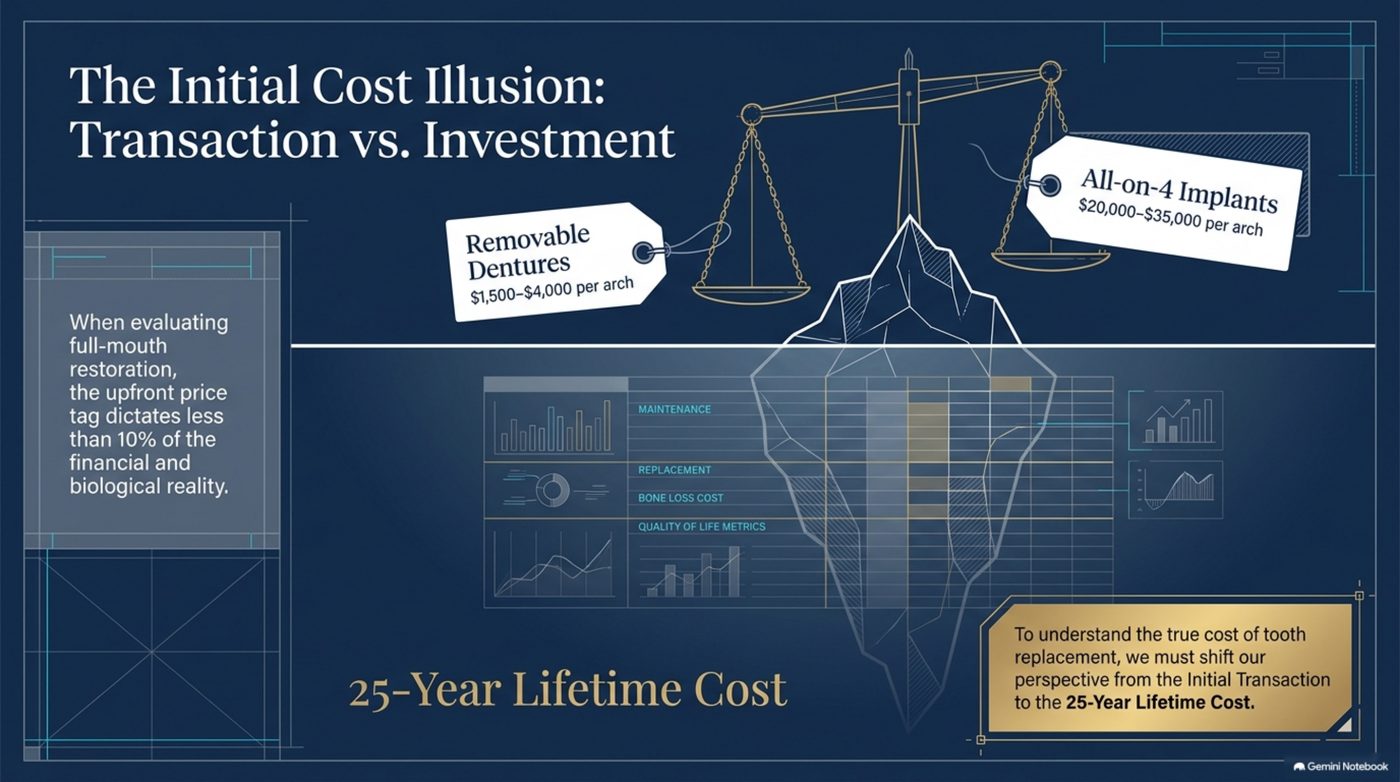
When someone in Scottsdale sits down to plan a full-mouth restoration, the first number on the page usually decides the conversation. All-on-4 implants are quoted at roughly $20,000 to $35,000 per arch. Removable dentures are quoted at $1,500 to $4,000 per arch. Neither figure is wrong. They are simply incomplete, and the distance between them explains why so many people pick the cheaper line item and then spend the next two decades paying for the difference. Most people who read this are comparing chipped tooth options around Scottsdale, AZ, so what follows sticks to the details that change in practice.
The upfront price tag dictates less than 10% of the financial and biological reality of tooth replacement. The other 90% sits in four places a standard estimate never itemizes: maintenance, replacement, bone loss cost, and quality-of-life metrics. A quote describes a transaction. A lifetime projection describes an investment.
The Four Ledgers That Never Appear on the Quote
Every tooth-replacement decision runs on four cost streams. Two are financial, two are biological, and only one of the four — the procedure itself — shows up on a normal estimate.
| Ledger | What it tracks | Why it is invisible up front |
|---|---|---|
| Maintenance | Adhesives, cleansing tablets, professional relines | Billed per visit, never bundled into the estimate |
| Replacement | Full prosthetic remakes as the mouth changes shape | Spread over years, easy to defer mentally |
| Bone loss cost | Grafting, and the treatment of a ridge that has narrowed | Emerges only after years of an unloaded jaw |
| Quality of life | Chewing power, speech, comfort, social confidence | Never priced at all |
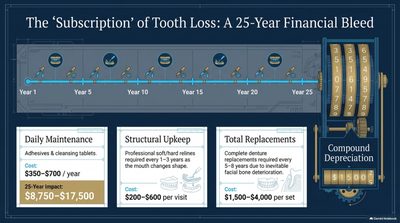
The maintenance ledger is the easiest to predict and the easiest to ignore, because it arrives in small amounts that never feel like dentistry. The replacement ledger compounds quietly, since each remake resets the clock rather than ending the cycle. The bone loss ledger is where biology starts charging interest: a jaw that is not being loaded by tooth roots does not hold still, and every year of that drift makes later correction more involved and more expensive.
The Two Entry Prices, Read Honestly
Per arch, both numbers deserve a closer look before they are compared. The implant figure covers a surgical placement, a set of abutments, a fixed temporary restoration, and the permanent prosthetic that follows healing. It is a single constructed outcome delivered in phases.
The denture figure covers the prosthetic itself. What surrounds it — the fit, the adhesive routine, the reline schedule, and the replacement cycle that begins almost immediately — is not part of the purchase. It is the running cost of ownership, and it starts in year one.
Read that way, the two prices are not describing the same thing. One is the price of a structure. The other is the price of admission to an ongoing arrangement.
What a 25-Year Lifetime Cost Comparison Actually Measures
Shifting the frame from the initial transaction to the 25-year lifetime cost is what turns two quoted numbers into a real decision. The question stops being which is cheaper today and becomes which is cheaper across the decades the treatment is actually worn.
- Transaction framing compares two one-time figures and stops there.
- Lifetime framing adds every reline, every replacement set, every adhesive refill, and every bone-related procedure into a single cumulative line.
- Biological framing asks whether the structure under the prosthetic is stronger or weaker in year 20 than it was in year 1.
That third question is the one a price sheet cannot answer, and it is the reason a higher opening number can still produce the lower total.
How to Read Any Quote You Are Handed
Ask three things of every estimate. First, ask what happens in year one, year five, and year ten and what each of those checkpoints costs. Second, ask whether the jawbone will be loaded or left idle, because that determines whether the foundation is improving or eroding. Third, ask for the cumulative projection rather than a set of separate line items, so you can see where the two paths cross.
A consultation in Scottsdale should end with a personalized 25-year financial plan rather than a single price. If a quote cannot be extended into that projection, it is describing a transaction, not an investment.
Totaling Both Paths on the Same Timeline
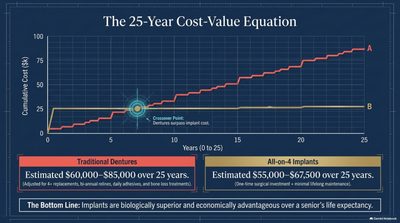
Line up the two pathways across 25 years and the comparison becomes mechanical. On the removable side, the first year is inexpensive and each subsequent year adds maintenance, with relines and replacement sets arriving on their own clocks. On the anchored side, the first year carries the full surgical figure and the years after it add very little. Draw both onto one axis and the removable line keeps rising while the anchored line turns flat.
That is why the opening numbers mislead. They sample a single point on two curves that behave completely differently afterward, and the point they sample is the one moment when the cheaper option genuinely is cheaper. Anyone making this decision should ask to see the projection rather than the point.
It also explains why the two estimates arrive in different forms. One is quoted as a price, because it is a discrete event with a defined end. The other is quoted as a starting point, because it is the beginning of an arrangement that continues for as long as the appliance is worn. Comparing a price to a starting point is what produces the illusion in the first place.
Free calculators: cost benchmark table hidden fee calculator 25-year ledger — all on the Scottsdale tools hub.
Frequently Asked Questions
Does the cheaper upfront option ever win over 25 years?
Sometimes, but rarely on the numbers alone. A removable appliance starts at a small fraction of the surgical cost, then adds recurring maintenance and periodic remakes. The comparison only becomes honest once those streams are added into the same column.
How do I compare two quotes fairly?
Normalize both into the same time window. Place every recurring cost on an annual line, count replacement cycles at their real interval, and add a bone-health line to each column. What remains after that is comparable.
Why does bone loss carry a cost at all?
Because idle jawbone shrinks, and a shrinking ridge eventually limits what can be placed without grafting. That later procedure is a cost created today by choosing a treatment that never loads the bone.