Replacing a Root, Not Just a Crown
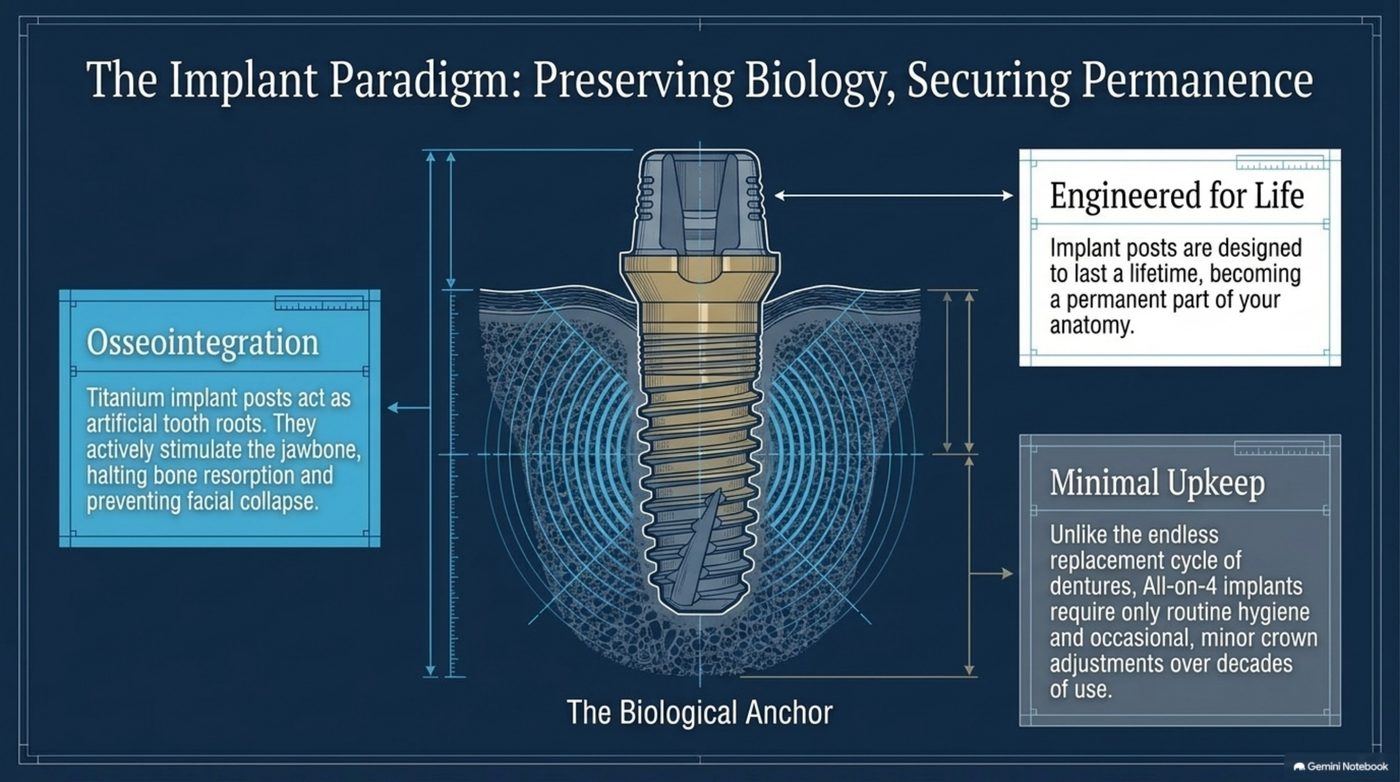
Most tooth-replacement options restore what is visible above the gum line. An implant restoration starts below it. A titanium post is placed into the jaw and becomes, over time, structurally connected to the bone around it — a process called osseointegration. The post functions as an artificial tooth root rather than a removable object resting on the ridge. This is written for people around Scottsdale, AZ who are looking into cosmetic dental treatment and want the honest version rather than a sales page.
That single difference separates a restoration that loads the jaw from one that merely covers it, and it is the reason the two pathways diverge so sharply over long horizons.
The Biological Anchor
Bone is a load-bearing tissue. It stays dense where it carries force and thins where it does not. Because implant posts are anchored into the jaw and loaded with every bite, they actively stimulate the surrounding bone instead of leaving it idle. Resorption is therefore halted rather than accelerated, and the facial structure that depends on that foundation is supported rather than left to narrow.
| What changes | Appliance resting on the gums | Implant anchored in bone |
|---|---|---|
| Bone stimulus | None — the ridge stays unloaded | Continuous, with every bite |
| Direction of change | Ridge narrows over time | Resorption is halted |
| Fit over time | Refilled repeatedly as shape changes | Stable anchor; minor adjustments only |
| Daily removal | Required | Not required |
| Expected service life | A recurring replacement cycle | Designed as a lifetime structure |
The Difference Between Covering and Loading
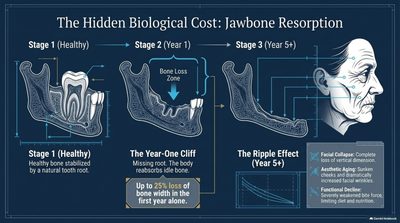
A removable appliance covers the ridge. That solves the cosmetic and chewing problems immediately, and it does so at a low entry price. What it does not do is put force back into the bone, which is the only signal that keeps bone from being reabsorbed.
An anchored restoration loads the bone through the post. The bite force travels into the jaw the way it did through the original root, and the body responds by maintaining the structure. The visible result is a smile that does not change shape over the years. The invisible result is a foundation that is still capable of supporting what sits on it a decade later.
The distinction matters most in the later years, when the two pathways have fully diverged. A covered ridge is a foundation in slow decline, and every future refitting is work done to catch up with a shape that has already moved. A loaded ridge is a foundation held in place, which is why the prosthetic sitting on it needs attention rather than replacement. Nothing about that outcome is cosmetic. It is the difference between maintaining a structure and managing a retreat.
Engineered for Life
Implant posts are designed to last a lifetime and to become a permanent part of the anatomy rather than a scheduled expense. The clinical frame is one of permanence: the structure is placed once, integrates with bone, and is then maintained rather than replaced. That is a fundamentally different relationship with treatment than an appliance expected to be remade every few years.
Minimal Upkeep Instead of an Endless Cycle
The recurring bills that define a removable pathway — adhesives, cleansing tablets, scheduled relines, complete remakes — do not carry over here. An implant restoration is maintained with routine hygiene and, occasionally, minor adjustments to the prosthetic crowns over decades of use.
- Daily: normal brushing and cleaning around the restoration, without soaking or adhesive.
- Periodic: professional monitoring of the implant and the tissue around it.
- Occasional: minor crown adjustments, not full replacements.
The upkeep is real, but it is small and predictable, which is the opposite of a compounding maintenance schedule.
Where This Fits in a Treatment Plan
Preserving biology and securing permanence are the same decision seen from two angles. A foundation that is being loaded stays usable, and a structure that is permanent only needs maintaining. Before that plan is built, the existing bone has to be assessed, because the amount remaining determines whether the anchors can be placed directly or whether the site needs preparation first. That assessment is done with imaging at a consultation rather than assumed from a timeline.
What Maintenance Looks Like Year to Year
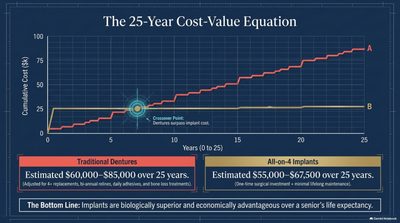
The contrast is clearest when both pathways are written out as a schedule. On the removable side, the calendar fills with routine supply purchases, a reline visit every one to three years, and a complete remake every five to eight. On the anchored side, the calendar stays comparatively empty: daily hygiene, professional monitoring, and the occasional minor adjustment to the prosthetic crowns.
That difference is not about discipline or effort. It is structural. A restoration anchored in bone has nothing to refill and nothing to remake on a timetable, because the foundation beneath it is being maintained by the load it carries with every bite.
The practical consequence over decades is that upkeep stays predictable and flat rather than compounding, which is what makes the long-horizon comparison come out the way it does.
Free calculators: jawbone loss estimator implant vs denture matrix healing timeline calculator — all on the Scottsdale tools hub.
Frequently Asked Questions
How long does osseointegration take?
It is a process measured in months rather than days, which is why the permanent prosthetic is placed after integration is confirmed rather than immediately after surgery.
Is the maintenance really that limited?
Daily hygiene plus professional monitoring and occasional minor adjustments covers it. There is no adhesive routine and no replacement cycle built into the plan.
Can everyone take this pathway?
Not everyone, and the deciding factor is bone. Where the ridge has already narrowed, grafting may need to come first. Imaging at a consultation answers that question directly.